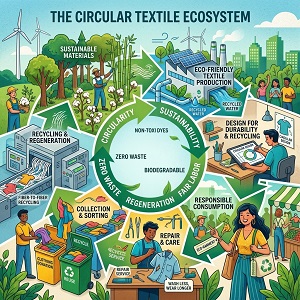

The readymade garment and textile industry in Bangladesh is taking a major step toward modernizing its core sector to become more environmentally friendly and globally competitive. This strategic milestone was officially sealed through the signing of a memorandum of understanding (MoU) on circular economy cooperation between the governments of Bangladesh and Belgium's European counterpart, the Netherlands.
Amid the hum of factory machinery running day and night, Vietnam’s apparel industry is celebrating a remarkable milestone. According to recent data, the country’s textile and garment export performance has shown an impressive upward trajectory. In July 2026, estimated textile and garment export turnover reached $4.67 billion, marking an 8.2 percent growth compared to June and a 4.3 percent increase year on year. Meanwhile, for apparel alone, July exports were estimated at $3.73 billion.
The first half of 2026 proved to be a challenging period for India’s textile and apparel sector in the United States market. According to trade data released by the Office of Textiles and Apparel (OTEXA), the shipment value of India's textile and garment products to the US fell sharply by about $1.25 billion, or 23.3 per cent, compared to the corresponding period in 2025.
Vietnam’s textile and garment sector has once again demonstrated its solid performance in international trade by the middle of 2026. Based on the latest report from the Customs IT and Statistics Department under the Ministry of Finance, total shipments of textile and apparel products—excluding yarn and fiber categories—successfully reached 22.863 billion dollars from January through July 2026. This achievement reflects a slight upward trend of 1.1 percent compared to the same period of the previous year.
Page 1 of 21