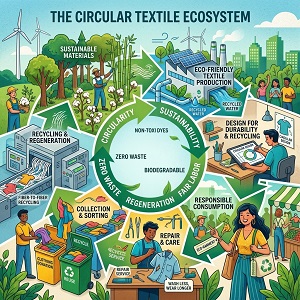

The European fashion industry is bracing for a monumental shift that promises not only ecological relief but also massive economic returns. According to a landmark study titled "State and Prospects of Circular Fashion in Europe," jointly released by KPMG and the Fédération de la Mode Circulaire (FMC), the European Union’s circular fashion sector could generate over €104 billion in annual revenue and unlock more than 88,000 new jobs by 2030. This structural transformation comes at a critical time for Europe's apparel sector, which has been severely challenged by subdued consumer demand, high structural energy costs, and fierce competition from low-cost Asian imports.
The heavy reliance on imported raw materials and mounting pressures from global climate change are driving the European Union to swiftly pivot toward a self-reliant green economy. At a strategic panel discussion initiated by the Bavarian Industry Association (vbw) in Brussels in mid-May 2026, industry leaders and policymakers gathered to map out the acceleration toward a circular bioeconomy. The dialogue centered primarily on leveraging renewable, bio-based resources to reinforce regional supply chains while maintaining European manufacturing's sharp edge in the global market.
As it celebrates its 20th anniversary in 2026, the Hong Kong Research Institute of Textiles and Apparel (HKRITA) is solidifying its position as a global circular economy pioneer through strategic technology expansion into Mainland China. Their cutting-edge innovation, known as the ‘Green Machine,’ was recently honored as one of the ‘20 Shanghai Outstanding ESG Cases’ at the Corporate Sustainability Development Conference. This achievement marks a new chapter in the $2.5 trillion global apparel industry’s effort to solve one of recycling's toughest bottlenecks: separating polyester-cotton blends.
Page 6 of 11