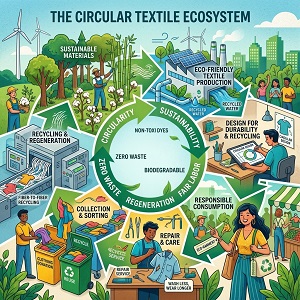

The global fashion industry is witnessing a fascinating paradigm shift in its environmental conservation efforts. Recent reports indicate that the concept of recycled clothing is no longer a fringe trend but has firmly entered the mainstream of mass production. According to data from UK-based supplier A.M. Custom Clothing, there has been an extraordinary 76 percent year-on-year increase in garments produced from recycled materials. However, behind this impressive growth lies a steadfast industrial reality: the volume of organic cotton remains seven times higher than recycled alternatives, proving that cotton remains the undisputed king of the global consumer's wardrobe.
Europe’s ambitions to build a circular textile economy are facing a harsh reality check. A new report titled “Advancing Textile Circularity,” released by Boston Consulting Group (BCG) and the upcycling initiative ReHubs, reveals that a staggering 11 billion euros (approximately $12 billion) in investment will be needed by 2035 to scale textile-to-textile recycling. Amidst tightening green regulations, the industry is struggling against a massive wall of waste driven by a global addiction to fast fashion.
The global textile industry is facing an unprecedented environmental turning point. With clothing production doubling over the last two decades, textile waste is accumulating in global landfills at a rate of one garbage truck every second. Amidst this crisis, a technological solution has emerged that is considered the "holy grail" of sustainability: Chemical Fiber-to-Fiber Recycling. This technology does not just recycle plastic bottles into fabric; it transforms old garment waste back into new fibers with a quality equivalent to virgin materials.
Page 8 of 11