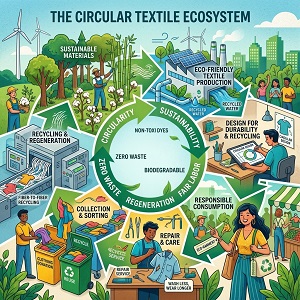

Europe is currently rewriting the rules of sustainability for the fashion industry through the most far-reaching set of regulations it has ever faced. However, amidst this grand ambition, barriers to scaling circular textiles continue to persist. This situation occurs not because of a lack of legislation, but due to the absence of the right financial and market conditions on the ground. Consequently, the Global Fashion Agenda has put forward a Call to Action to urge policymakers at both the national and EU levels to study and introduce the necessary incentives to make circularity work in practice.
The global apparel industry is entering a critical redesign phase driven by sustainability goals, tightening regulatory pressures, and resource security centered around a single core principle: material simplicity. For years, consumers were encouraged to look for garments labeled "100% cotton" or "100% polyester" to support recyclability. Today, that label has evolved far beyond a basic sustainability marker, serving as a key indicator of how prepared a brand is for the next era of textile manufacturing.
Public awareness regarding environmental issues and microplastic waste has achieved significant momentum worldwide in recent years. Based on a comprehensive survey released by Cotton Incorporated, which surveyed 28,813 consumers across multiple countries, cotton has emerged as the safest natural fiber for the environment. An overwhelming 85 percent of global respondents believe that cotton is environmentally safe, securing the top position ahead of wool at 81 percent, silk at 76 percent, and hemp at 69 percent.
Page 2 of 11